
About Us
Welcome To Jind
Jind, located in central Haryana, is a historic city often referred to as the “heart of Haryana,” known for its deep roots in the Mahabharata epic. Founded as Jaintapuri around a temple dedicated to the goddess of victory, Jainti Devi, it serves as a key administrative district headquarters.Key Details About Jind, Haryana: Historical Significance: According to tradition, the town was founded by the Pandavas during the Mahabharata era. Location & Geography: Situated in northern India, it acts as a central hub with road and rail connectivity to Delhi and Panipat.Key Attractions: Famous for numerous Shiva temples, including the prominent Bhuteshvara temple and the historical Rani Talab (a water tank).Economy: The district acts as a local grain trade center with agricultural-based industries like cotton-ginning factories.Major Towns: Besides Jind city, the district includes areas like Narwana, Safidon, Uchana, and Julana.Climate: The region experiences hot summers and cold winters.Jind is recognized as one of the oldest districts in Haryana, playing a significant role in the state’s cultural and historical landscape.
OverView

Jind is a historic city and district headquarters in central Haryana, India, known as the “heart of Haryana” and one of its oldest districts.
Founded during the Mahabharata era as Jaintapuri, it is a significant Jat-belt region with deep religious roots, numerous Shiva temples, and a prominent role as a former Sikh Kingdom.
Located in central Haryana, the district features level plains and acts as a major agricultural, road, and rail hub connecting to Delhi and Panipat.History & Culture: Historically, the city was a capital of a Sikh state established by Maharaja Gajpat Singh in 1776. It is known for its cultural significance, with sites like the Bhuteshvara Temple and Rani Talab. Economy: The area serves as a local center for grain trade and features various industries, including cotton-ginning.Key Locations: Major towns within the district include Narwana, Safidon, Uchana, and Julana.Climate: The region experiences a hot summer and a cold winter, with an average annual rainfall of about 18 inches.
Geography & Location
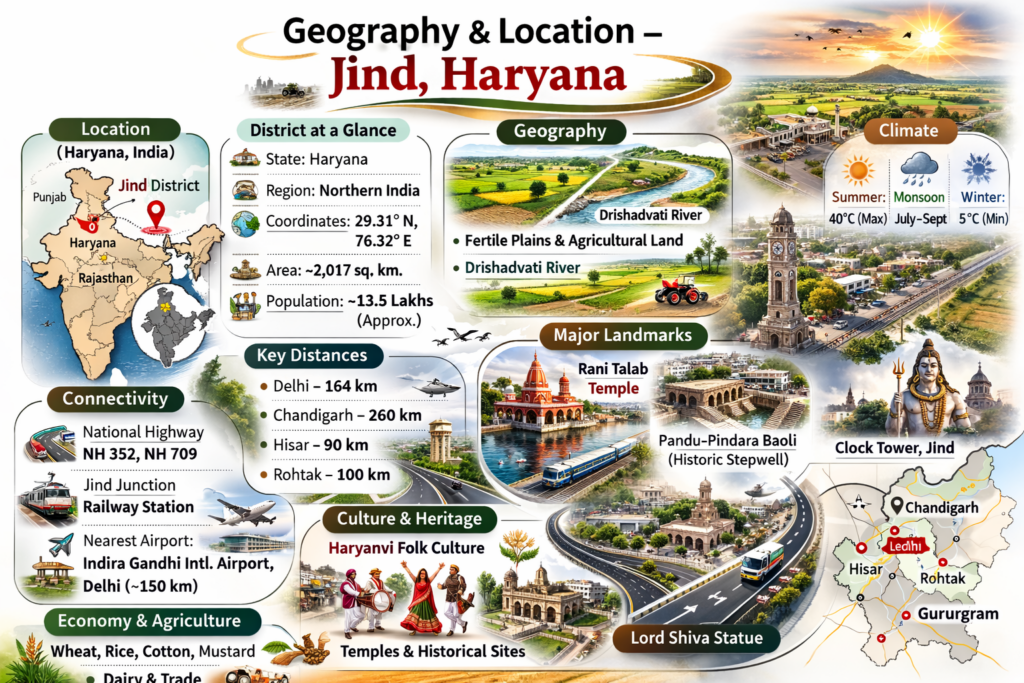
“Geography & Location – Jind,Haryana.” It presents a comprehensive visual overview of Jind district in Haryana, India, combining maps, icons, landmarks,and key statistics in a clean, organized layout.
Location:Shows Jind’s position within Haryana, India,highlighted on a state and national map. Indicates nearby states such as Punjab, Rajasthan, and Uttar Pradesh.
Location.pin.DistrictatGlance.State:Haryana.Region:Northern.Coordinates:29.31°N,76.32°E.Area:Approximately,2,017sq.km.Population:Around,13.5lakhs.Geography:Highlights fertile plains and agricultural land.Mentions the Drishadvati River as a key geographical feature.Includes scenic visuals of farmland and rural,landscapes.Climate:Summer:Upto:40°C(maximum).Monsoon:JulySeptember.inter:Around5°C.Connectivity:National.Highways:NH 352 and NH 709.Railway access via Jind Junction Railway Station.Nearest airport:Indira Gandhi International Airport,Delhi (~150 km).Road and rail connectivity emphasized with highway and train.
History & Cultural Heritage of Jind
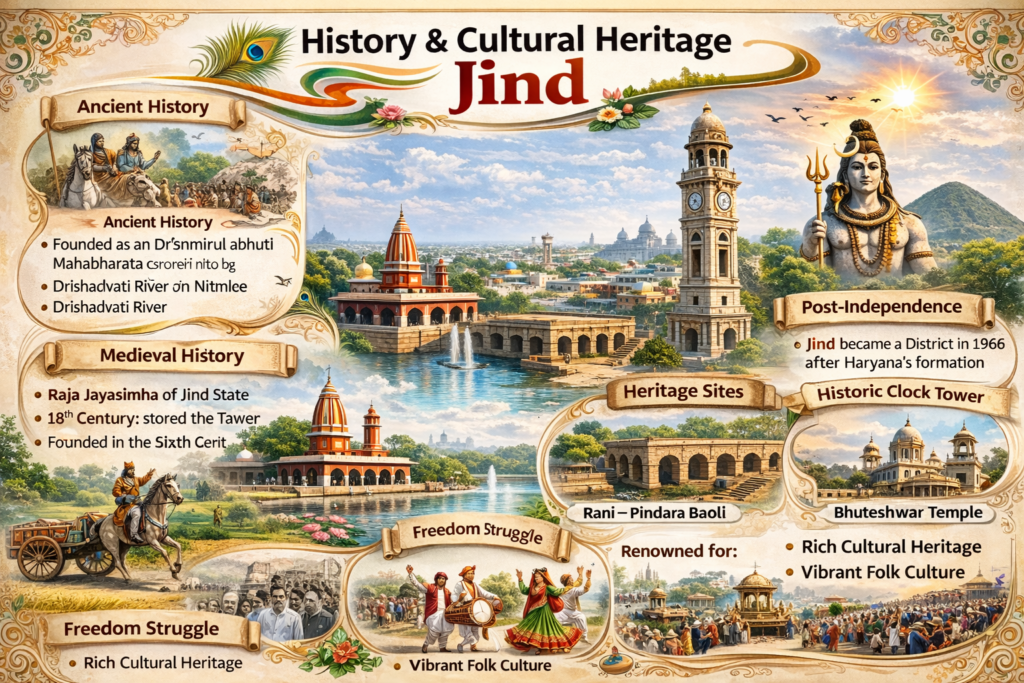
“History & Cultural Heritage – Jind.” It visually presents the historical journey and cultural identity of Jind through artistic illustrations, heritage landmarks, and thematic sections arranged in a decorative traditional Indian frame.
The poster features an ornate border with floral motifs and a peacock feather design at the top.The title “History & Cultural Heritage – Jind” is prominently displayed in bold, elegant typography.
The background showcases a scenic panoramic view of Jind city with temples, water bodies, greenery, and a historic clock tower.A large statue of Lord Shiva appears on the right side, symbolizing spiritual significance.Depicts scenes inspired by the Mahabharata era with warriors and sages. Mentions association with the ancient Drishadvati River. Highlights Jind’s mythological roots and early settlement history. References Raja Jayasimha of Jind State. Notes developments during the 18th century. Shows a traditional temple complex near a water reservoir.
Agriculture – The Backbone of jind
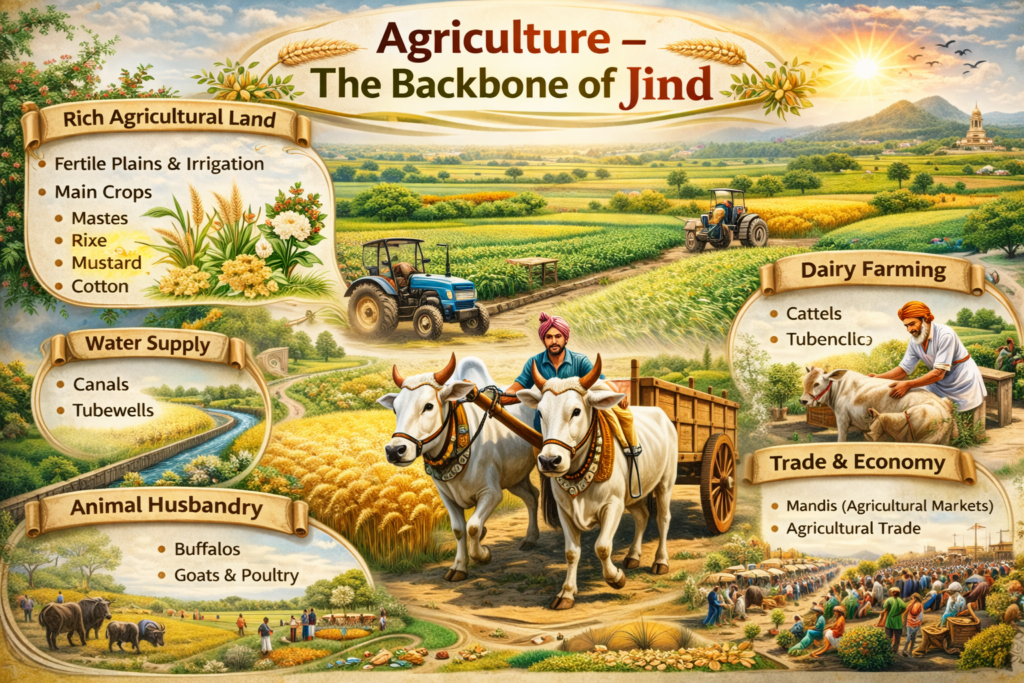
“Agriculture – The Backbone of Jind.” It visually highlights the importance of farming and allied activities in Jind through scenic illustrations, structured information panels, and traditional rural elements.
The title is prominently displayed at the top with decorative wheat motifs.The background features expansive green and golden fields under a bright sunrise, symbolizing prosperity and growth.
The design blends modern farming with traditional agricultural practices. This section emphasizes the fertility of Jind’s land: Fertile,Plains&Irrigation.Main Crops: Wheat, Rice, Mustard, Cotton. crop bundles and flowering plants visually represent agricultural abundance. Tractors working in lush green fields represent mechanized farming.A farmer guiding two oxen pulling a wooden cart symbolizes traditional agricultural practices still valued in rural areas.Golden wheat fields in theForeground,highlight,seasonal,harvesttime.irrigationsources:Canals,Tubewells.A flowing canal cutting through fields demonstrates how irrigation supports year-round.
Tourism & attractions in jind

“Tourism & Attractions in Jind.” It presents Jind as a culturally rich and scenic destination, combining religious landmarks, heritage sites, natural beauty, and vibrant local life in a single panoramic composition.
The title appears prominently at the top with decorative tricolor-style curves and leafy motifs.The background features lush greenery, a serene lake, distant hills, and a bright sky with birds in flight.A large statue of Lord Shiva on the right adds spiritual symbolism to the composition.
Rani-Talab-Temple,Pandu-Pindara-Baoli,Dhamtan-Sahib Gurudwara,Bhuteshwar-Temple,Historic-Clock-Tower,Taluvan Lake. Local Markets:A vibrant marketplace scene is shown at the bottom right.Vendors selling fruits and vegetables. People shopping in traditional attire. Demonstrates local culture, trade, and daily life.Scenic Surroundings, Fields, rural roads, and village scenes highlight countryside charm.A traditional bullock cart scene emphasizes rural heritage.Green landscapes enhance the tourist.
Connectivity and infrastructure in jind
Frequently Asked Questions
Answer:- Jind is located in central Haryana and is one of the oldest districts, holding significant historical and mythological importance.
Answer:-The town was formerly known as Jaintapuri (Abode of Jainti Devi), a place mentioned in the Mahabharata.
Answer:- It was one of the original 7 districts created on November 1, 1966, when Haryana was carved out of Punjab.
Answer:- As per the 2011 census, the population was 1,334,152 with a literacy rate of 71.4%.
Answer:- There are four sub-divisions: Jind, Narwana, Safidon, and Uchana.